




Nortech — People & Vehicle Access Solutions
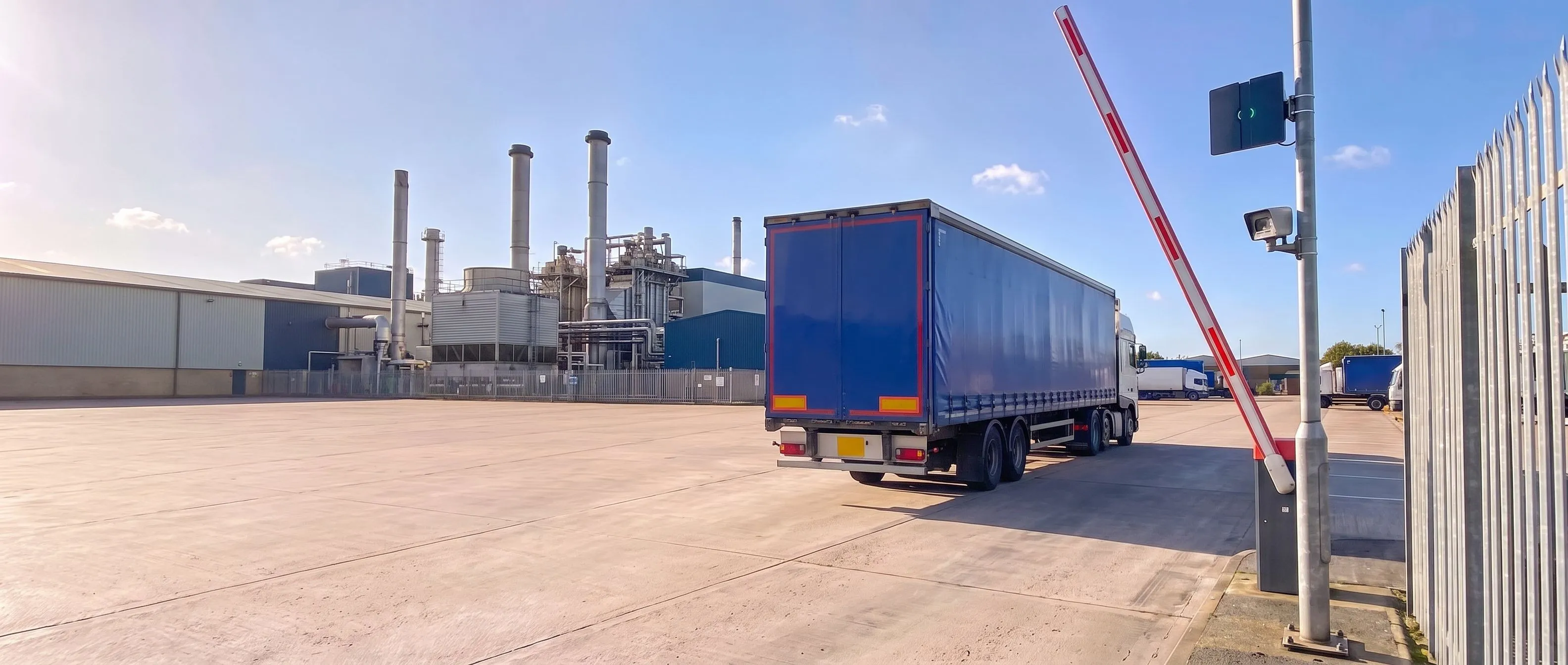
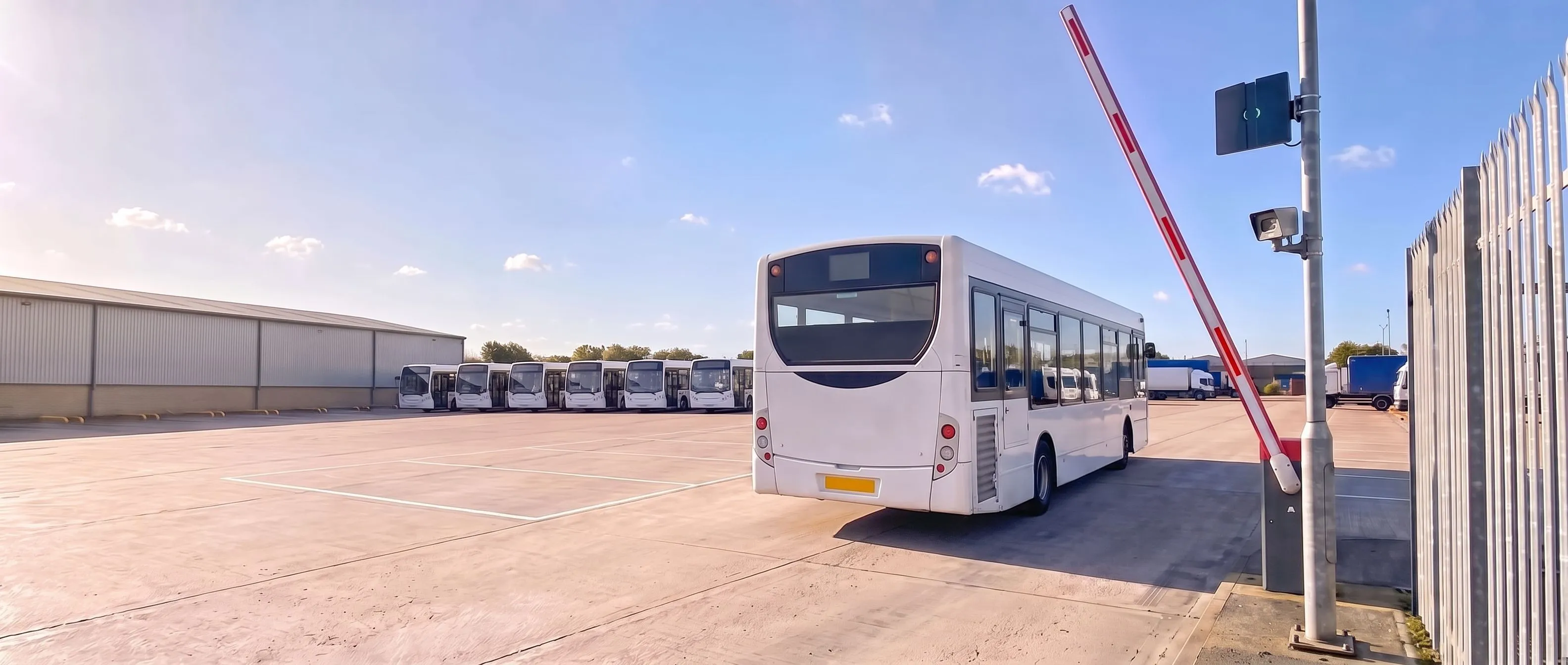
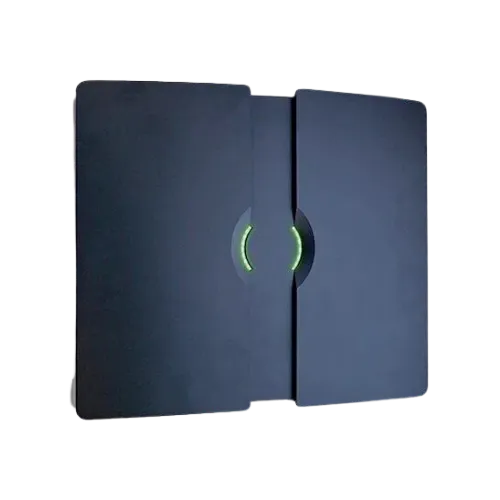
Single-deck bus driving through the raised barrier at a depot gate, with a Transit Ultimate long-range reader and a camera on the post beside it

Vehicle access control for bus and rail depots

Fleet movements, dwell tracking, depot security.

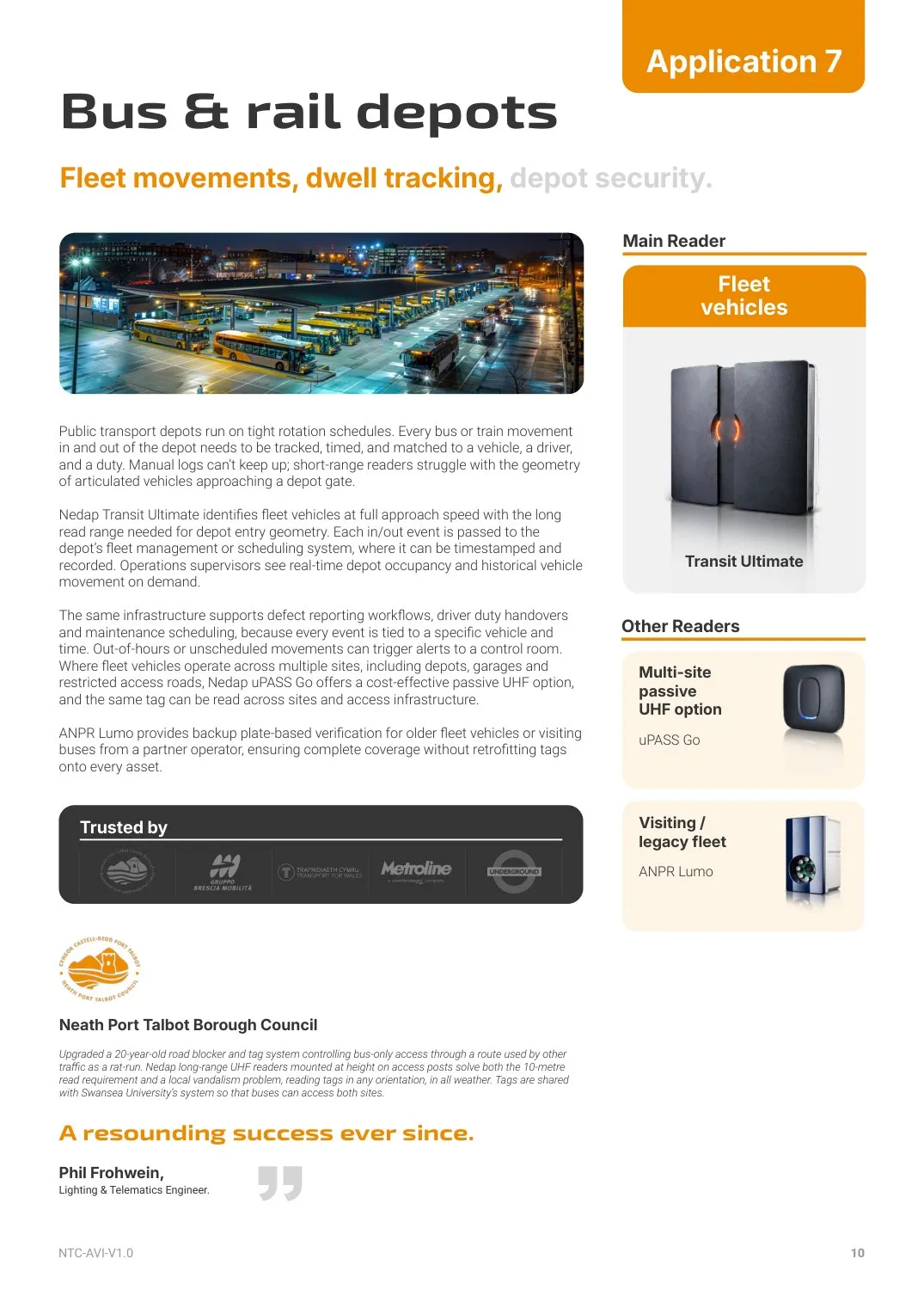
Trusted by

Vehicle access control for a bus or rail depot has to track every movement in and out, match it to a vehicle and keep the fleet moving on a tight rotation. Nedap Transit Ultimate identifies fleet vehicles from up to 15 metres at full approach speed, uPASS Go reads the same passive tag across depots, garages and restricted roads, and ANPR Lumo covers older vehicles and visiting buses by number plate.

We distribute and support all three as Nedap's certified UK partner, and work with your installer from specification to commissioning.

Every movement matched to a vehicle, a driver and a duty

Public transport depots run on tight rotation schedules. Every movement in and out needs to be tracked, timed and matched to a vehicle, a driver and a duty, and manual logs can't keep up.

Short-range readers struggle with the geometry of a long or articulated vehicle approaching a depot gate: the reader on the post is nowhere near the driver's window.

At a rail depot or freight yard the same applies to the road vehicles that serve it: maintenance crews, staff and the HGVs at an intermodal terminal.

  • The challenge

    Articulated vehicles at the depot gate

    A short-range reader on a post is out of the driver's reach on a long or articulated vehicle, so buses stop and queue at the gate.

    The answer

    Fleet vehicles read at full approach speed

    Transit Ultimate reads a windscreen tag from up to 15 metres, the range a depot entry needs, so the bus is identified without slowing and the barrier is opening as it arrives.

  • The challenge

    Movements that have to be matched to a duty

    Every in and out has to be tied to a vehicle, a driver and a time, and a manual log at the gate cannot keep pace with the rotation.

    The answer

    Every in and out event timestamped

    Each read is passed to the depot's fleet management or scheduling system, so supervisors see live depot occupancy and the history of each vehicle's movements.

  • The challenge

    Several sites, one fleet

    Depots, garages and restricted access roads each need a reader, and a tag that only works at one of them is no use to a fleet.

    The answer

    One tag read across every site

    uPASS Go is the cost-effective passive UHF option, and the same tag is read at every site and access point the fleet uses.

  • The challenge

    Older vehicles and partner operators' buses

    Not every vehicle on the depot carries a tag: older fleet, and visiting buses from a partner operator.

    The answer

    Number plates as the fallback

    ANPR Lumo reads the plate from 2 to 10 metres, so there is complete coverage without retrofitting tags to every vehicle.

Which reader for which vehicle

A depot gate sees the operator's own fleet, the same fleet at other sites, and the occasional vehicle without a tag. Each is identified in the way that suits it, and every reader reports to the same system.

Main reader

Fleet vehicles

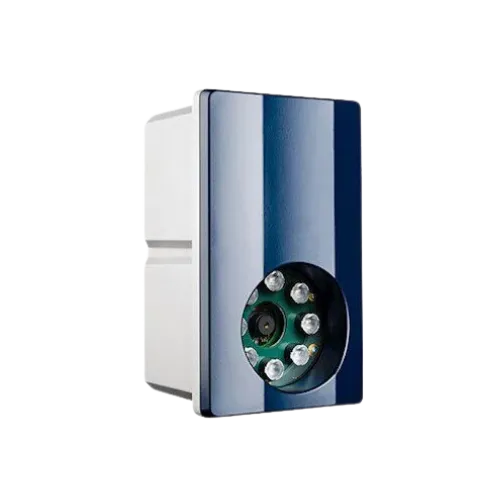
Nedap Transit Ultimate

Each bus carries a tag in the windscreen, and Transit Ultimate reads it at full approach speed with the long range a depot entry needs. Every in and out event is passed to the fleet management or scheduling system, where it is timestamped against the vehicle, and an out-of-hours or unscheduled movement can raise an alert in the control room.

Reads
Semi-active tag in the windscreen
Read range
Up to 15 metres
Vehicle speed
Up to 200 km/h (125 mph)

Multi-site passive UHF option

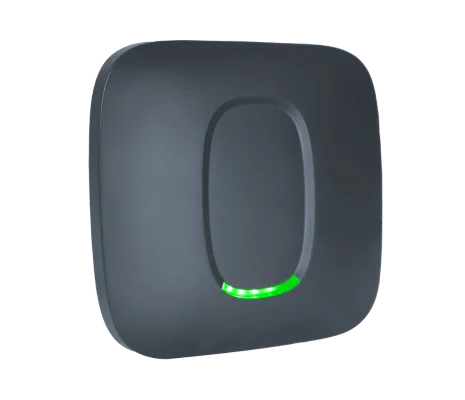
Nedap uPASS Go

Where the fleet moves between depots, garages and restricted roads, the same battery-free tag is read at every site.

Reads
Battery-free UHF windscreen tag
Read range
Up to 10 metres

Visiting and legacy fleet

Nedap ANPR Lumo

Older vehicles and visiting buses from a partner operator are identified by number plate, with no tag to fit.

Reads
The number plate, with no tag
Read range
2 to 10 metres

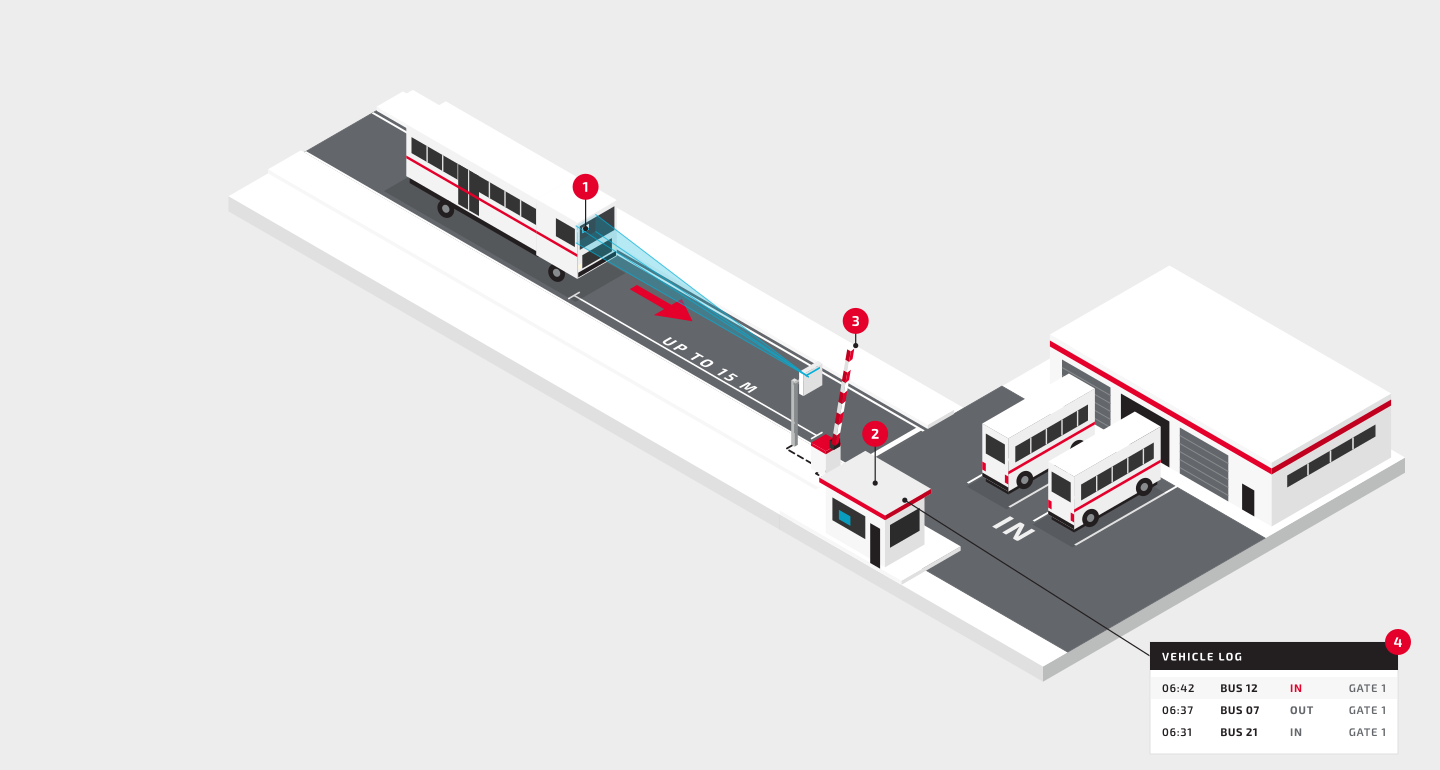
How Transit Ultimate works at the depot gate

Isometric view of a bus depot gate: a Transit Ultimate reader on a pole reads the tag in an approaching bus's windscreen from up to 15 metres, the gatehouse system checks it against the fleet list, the barrier opens and the movement appears in the vehicle log, with the depot and two parked buses beyond
  1. Bus approaches

    Transit Ultimate reads the windscreen tag from up to 15 metres while the bus is still moving.

  2. Identity checked

    Norpass3, or the fleet system already on site, checks it against the fleet list.

  3. Barrier opens

    No stopping, and the driver stays on schedule.

  4. Movement logged

    Vehicle and time, for depot occupancy and the duty record.

Beyond the depot gate

Because every event is tied to a vehicle and a time, the same readers serve the rest of the operation.

  • Bus-only access roads

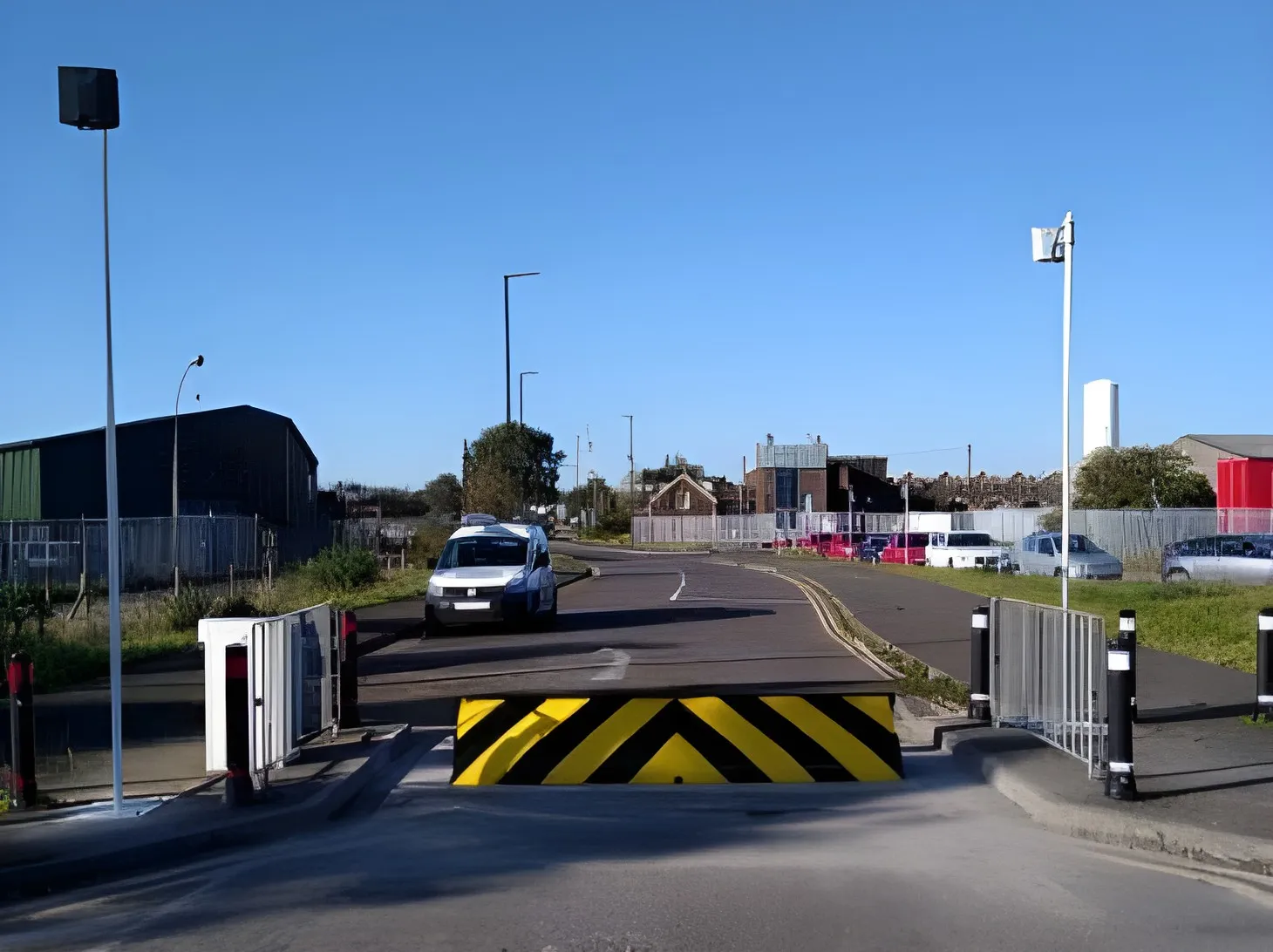
    A reader at a bus gate or road blocker lets buses through a route closed to other traffic, as on Neath Port Talbot Council's route.

  • Garages and outstations

    uPASS Go reads the same tag at every site the fleet uses, so one tag covers depots, garages and restricted roads.

  • Fuel island and wash lane

    A reader there ties each visit to a vehicle and a time, for the maintenance schedule and defect reporting.

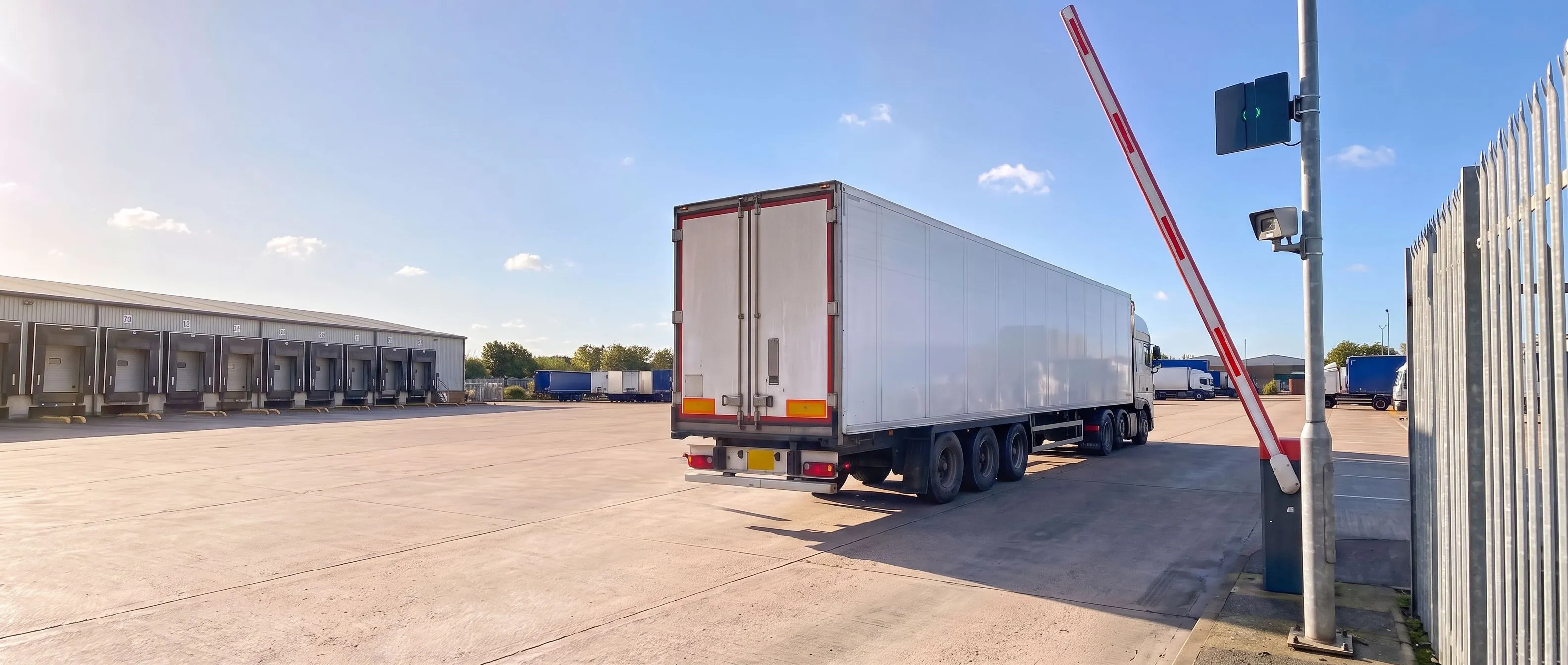
  • Rail freight and intermodal terminals

    HGVs collecting and delivering containers are identified like any registered fleet, with ANPR Lumo for hauliers without a tag.

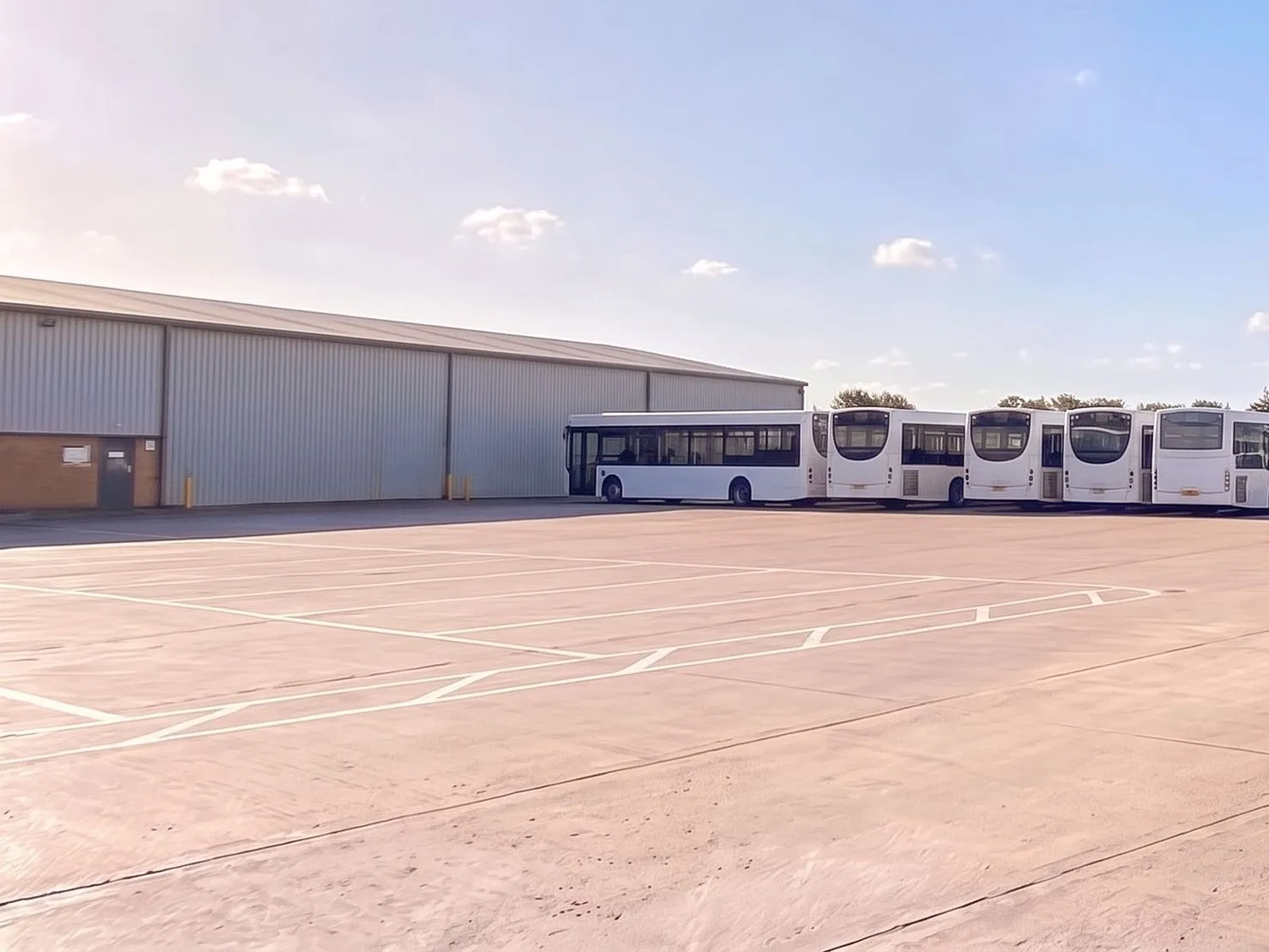
Bus depot yard with a row of parked single-deck buses in front of the depot building

The Nedap applications catalogue

Bus & Rail Depots is one of 11 applications in Vehicle Access, Solved, the Nedap vehicle identification catalogue we publish for the UK and Ireland. Each page shows which reader does the main job, where a second reader picks up untagged or visitor vehicles, and a site where it is in use.

15 pages, PDF. Bus & Rail Depots is on page 10.

Open the applications catalogue

Case study

Neath Port Talbot County Borough Council

The council's bus-only route had been controlled for twenty years by road blockers and a tag system, on a road other drivers used as a rat-run. The readers were due for renewal, vandalism was a problem, and the tags had to work with the system already in use at Swansea University.

On Nortech's advice, Frontier Pitts fitted Nedap long-range UHF readers with a 10-metre read range, mounted high on the access posts out of reach, reading tags in any orientation and in all weather. Buses now use the same tag at both sites.

  • Vehicles detected at up to 10 metres
  • Readers mounted high on the posts, out of reach of vandals
  • Tags read in any orientation and in all weather
  • The same tags work at Swansea University

Installed by Frontier Pitts Ltd.

Read the full case study ›

‘The choice of uPASS Target readers and vehicle tags provided us with solutions to our initial problems and has been a resounding success ever since.’

Phil Frohwein, Lighting & Telematics Engineer, Neath Port Talbot County Borough Council

Works with the fleet management system already in place

None of the readers needs its own software. Each one hands the tag or plate number to an access control system as a standard reader, so it can be added to the system a depot already runs or to Norpass3, our licence-free access control software.

From there each in and out event can be passed to the fleet management or scheduling system, where it is timestamped and recorded against the vehicle. Because every event is tied to a specific vehicle and time, the same data supports defect reporting, driver duty handovers and maintenance scheduling, and an out-of-hours or unscheduled movement can trigger an alert to the control room. ANPR Lumo also has an Ethernet connection and a REST interface, so plate reads can be sent straight to other software.

Our engineers work through the integration with you or your installer before the hardware is specified, and stay involved through commissioning.

ReaderOutputs and interfacesProtectionDatasheet
Transit Ultimate Outputs and interfaces Wiegand, magstripe and barcode outputs. RS232 as standard, with RS422, RS485, TCP/IP and Profibus DP interface boards Protection IP66 Transit Ultimate datasheet
uPASS Go Outputs and interfaces Wiegand and magstripe (clock and data) outputs Protection IP66 uPASS Go datasheet
ANPR Lumo Outputs and interfaces Wiegand, RS485 and Ethernet, with a REST interface for other software Protection IP65 ANPR Lumo datasheet

Bus and rail depot vehicle access control FAQs

What is vehicle access control for a bus depot?

Vehicle access control for a bus depot identifies each vehicle arriving at or leaving the depot gate and decides whether the barrier should open. Fleet vehicles are identified by a long-range RFID tag, older or visiting vehicles by number plate, and every movement is logged with the vehicle and the time.

Do buses have to slow down at the depot gate?

Not to be identified. Transit Ultimate reads a windscreen tag from up to 15 metres at vehicle speeds of up to 200 km/h, so a bus is identified at its normal approach speed and the barrier can be opening as it arrives. A short-range reader on a post, by contrast, is often out of the driver's reach on a long or articulated vehicle.

Can the system tell us which vehicles are on the depot?

Each in and out event is timestamped and passed to the depot's fleet management or scheduling system, which can then show current depot occupancy and each vehicle's movement history. What it shows depends on that system.

Can one tag work at several sites?

Yes. uPASS Go reads the same passive UHF tag at every site the fleet uses, so one tag covers depots, garages and restricted access roads. Neath Port Talbot Council's buses use the same tags on its bus-only route and at Swansea University.

What about older buses and partner operators' vehicles?

ANPR Lumo reads the number plate from 2 to 10 metres, so an older vehicle or a visiting bus from a partner operator is identified without a tag being fitted.

Will it work with our fleet management system?

In most cases, yes. Transit Ultimate, uPASS Go and ANPR Lumo all have a Wiegand output, so an access control system sees each one as a card reader, and ANPR Lumo can send plate reads to other software over its REST interface. How events reach a fleet management or scheduling system depends on what it accepts, which our engineers can work through with you.

How much does vehicle access control for a depot cost?

It depends on the number of gates and sites, how many vehicles need tags, whether older or visiting vehicles are read by ANPR, and the barrier or gate work your installer carries out. Our ANPR system cost guide covers typical camera and installation costs, or ask us for a quote for your site.

Related products

New

Nedap uPASS Go

Based on battery-free passive UHF technology, the uPASS Go reader provides a cost-effective solution for convenient vehi…

› View Details

Talk it through with an engineer

Every depot is different, and every fleet system has its quirks. Before the hardware is specified, talk to someone who has done it before.

Our engineers in Cwmbran will help you scope the application, recommend the reader mix, work through the integration with the systems already in place, and stay with you through commissioning. When you call, it's an engineer who answers.

Call +44 (0)1633 485 533

It helps to know

  • How many depots, gates and lanes there are, and roughly how many movements a day
  • Who arrives: your own fleet, partner operators, staff, contractors
  • The barriers or road blockers and the fleet or access control system already in place

Loading the form…

We're here to help

Call +44 (0)1633 485 533 or Email Us